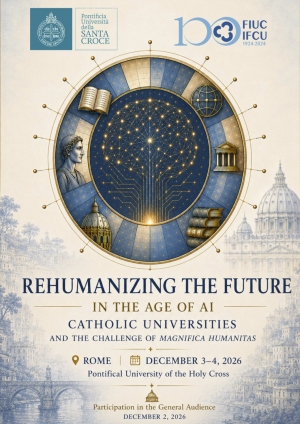
Prof. Martín Carbajo-Núñez, OFM, has been invited by the International Federation of Catholic Universities (IFCU) to participate as a speaker at the International Conference "Rehumanizing the Future in the Age of Artificial Intelligence: Catholic Universities and the Challenge of Magnifica Humanitas", to be held on December 3–4, 2026, at the Pontifical University of the Holy Cross in Rome.
The invitation, signed by IFCU Secretary General Dr. François Mabille, acknowledges Fr. Carbajo's scholarly contributions in the fields of social ethics, fraternity, integral ecology, and the governance of emerging technologies. It also highlights the significance of his work in fostering dialogue between Catholic Social Teaching and the ethical challenges posed by artificial intelligence.
The conference will bring together university presidents, scholars, Church leaders, public officials, and experts from five continents to reflect on the mission of Catholic universities in responding to the profound anthropological, educational, ethical, and geopolitical transformations brought about by artificial intelligence and other emerging technologies. It is expected to be one of the first major international academic events devoted to the reception of Pope Leo XIV's Apostolic Exhortation Magnifica Humanitas.
Prof. Martín Carbajo-Núñez will participate in the roundtable discussion "Governing Artificial Intelligence at the Service of Humanity," alongside Sr. Alessandra Smerilli, F.M.A., from the Dicastery for Promoting Integral Human Development, and Fr. Jossy P. George, CMI, of Christ University (India). Their dialogue will explore the ethical principles, responsibilities, and forms of international cooperation needed to ensure that the development of artificial intelligence remains at the service of human dignity, integral human development, and the common good.
This invitation coincides with the forthcoming publication of Fr. Carbajo's new book, currently in preparation, which explores the relationship between the Franciscan intellectual tradition, artificial intelligence, and Magnifica Humanitas. The book proposes a humanistic reconstruction of modernity grounded in the principle of fraternity, showing how the Franciscan tradition can offer valuable criteria for guiding scientific and technological development toward the service of the human person, the common good, and an authentic culture of encounter.
Fr. Carbajo's participation in this international conference reflects his ongoing academic commitment to promoting interdisciplinary dialogue among theology, ethics, the social sciences, and emerging technologies, with the aim of fostering a governance of artificial intelligence inspired by human dignity, universal fraternity, and the common good.