 Carbajo-Núñez Martín ,
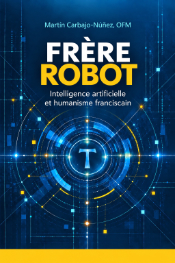
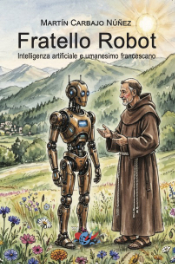
Brother Robot. Artificial Intelligence and Franciscan Humanism,
Ed. TAU Publishing,
Carmel (IN),
2026
, 275.
Carbajo-Núñez Martín ,
Brother Robot. Artificial Intelligence and Franciscan Humanism,
Ed. TAU Publishing,
Carmel (IN),
2026
, 275.
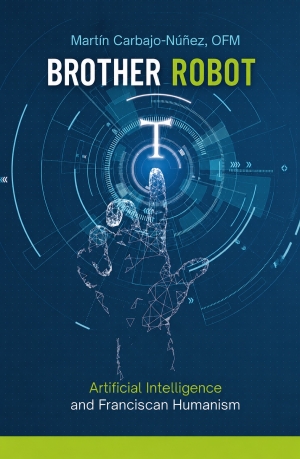
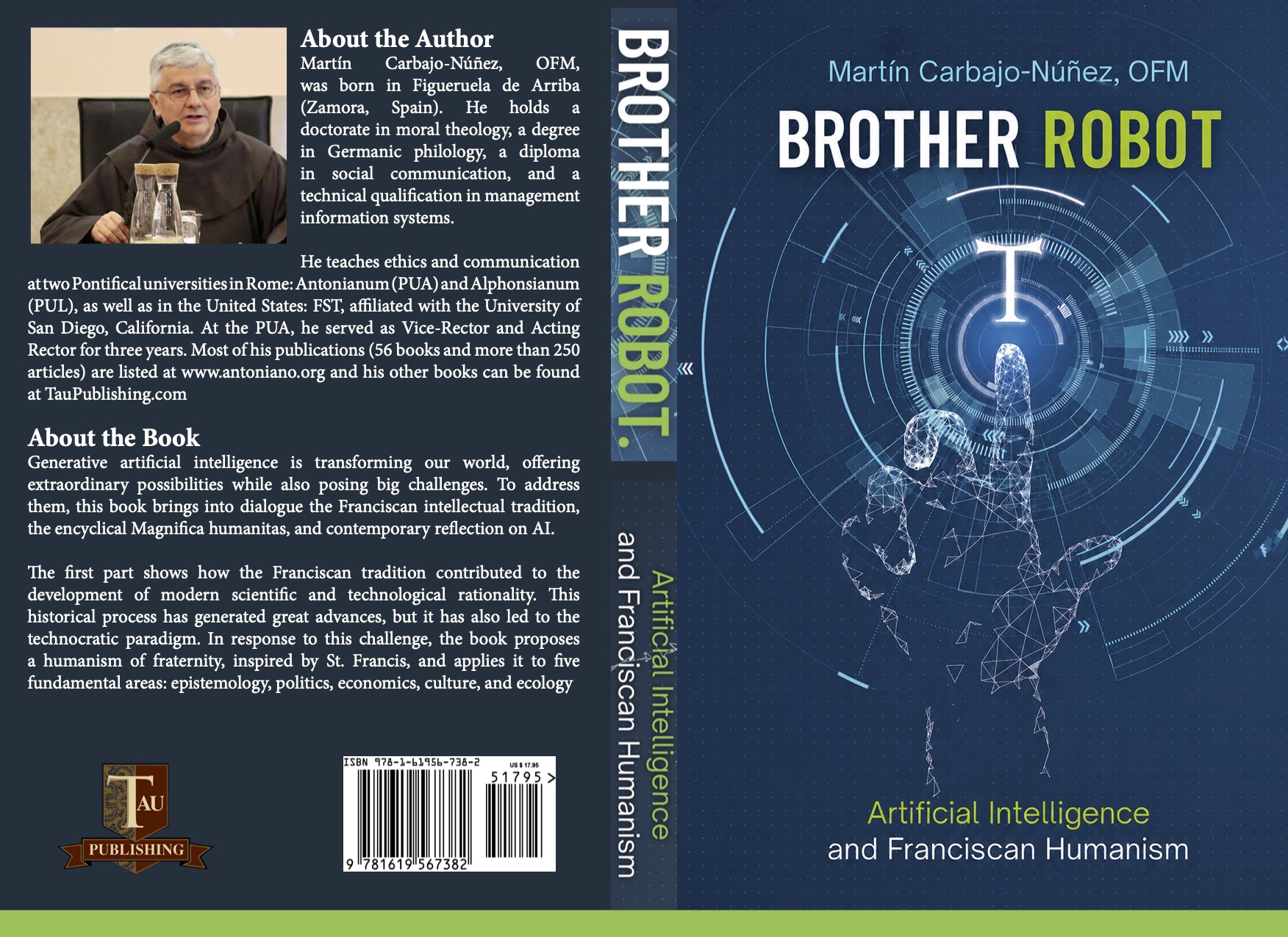
Prof. Martín Carbajo Núñez, OFM, has published Brother Robot. Artificial Intelligence and Franciscan Humanism, a new book examining the challenges posed by generative artificial intelligence from the perspective of the Franciscan intellectual tradition.
Published by TAU Publishing, based in Carmel, Indiana (United States), the book brings together the Franciscan intellectual tradition, the encyclical Magnifica humanitas, and contemporary reflection on artificial intelligence. It starts from the recognition that generative AI is rapidly transforming society, offering extraordinary possibilities while also raising significant ethical, anthropological, social, and ecological questions.
The first part of the book traces the contribution of the Franciscan tradition to the development of modern scientific and technological rationality. Carbajo Núñez also examines the consequences of this historical process and its relationship with the emergence and consolidation of the technocratic paradigm.
In response to these challenges, the author proposes a humanism of fraternity, inspired by St. Francis of Assisi, as a framework for rethinking the relationship between technology and humanity. This approach is developed across five fundamental areas: epistemology, politics, economics, culture, and ecology.
The book explores how artificial intelligence is changing processes of knowledge and understanding, creating new forms of political and economic power, transforming culture and work through automation, and raising questions about the ecological impact of technological development.
At the heart of the book is the question of what kind of humanity should be built in a society increasingly shaped by artificial intelligence. Rather than approaching technology solely from an instrumental perspective, the author emphasizes the importance of fraternity, responsibility, the common good, and care for creation.
Brother Robot. Artificial Intelligence and Franciscan Humanism has been published in English under ISBN 978-1-6195b-738-2 and is available for $17.95.
The book can be purchased through the TAU Publishing online store: TAU Publishing — Brother Robot
The book is now available also in French and Italian, with Portuguese and Spanish editions forthcoming.
With this publication, Carbajo Núñez continues his reflection on the ethical and anthropological implications of emerging technologies and on the contribution that Franciscan thought can make to the contemporary debate on artificial intelligence.
Index:
ABBREVIATIONS 4
1. Biblical Books 4
2. Magisterium Sources 4
3. Writings of St. Francis 5
4. Franciscan Sources and Authors 6
5. Bibliographical and Common 7
INTRODUCTION 9
Magnifica Humanitas and the Franciscan Tradition 10
Working Hypothesis 11
Can a Robot Be Our Brother? 11
The Organizing Principle: Fraternity 13
Structure and Content 14
Toward a Humanistic Reconstruction of Modernity 15
PARTE I HISTORICAL ROOTS 17
1. THE FRANCISCAN CONTRIBUTION TO SCIENTIFIC AND
TECHNICAL RATIONALITY 17
1.1. Theological and Epistemological Foundations 19
1.1.1. Two Models: Intellectualism and Voluntarism 20
1.1.2. The Importance of Empirical Observation and Technology 23
1.2. The Empirical Turn and the Process of Rationalization 24
1.2.1. The Beginnings of Modern Experimental Science (Bacon) 25
1.2.2. Foundations of Modern Epistemology (Ockham) 28
1.2.3. Nature, Contingency, and the Limits of Technology 31
1.2.4. Rationalization of Knowledge (R. Bacon and L. Pacioli) 32
1.3. Politics 34
1.3.1. Subjective Rights (Ockham) 34
1.3.2. Contingency of Political Order 36
1.3.3. Absolutism and Church–State Relations (Ockham) 36
1.3.4. Constitutionalism, Popular Sovereignty, and the Social Contract (Eiximenis) 38
1.4. Economy 40
1.4.1. Economy as a Rational and Moral Sphere (Olivi) 40
1.4.2. Political Management of the Market on Rational Foundations (Eiximenis) 41
1.4.3. The Value of Money and Social Trust (Eiximenis and Alexander of Alessandria) 42
1.4.4. Double-Entry Bookkeeping (Pacioli) 44
1.4.5. Technology and Proto-Science: Alchemy (13th–15th c.) 46
1.5. Culture 47
1.5.1. Foundations of Ethnographic Studies 48
1.5.1.1. The Philippines and Other Eastern Peoples 49
1.5.1.2. New Spain: Bernardino de Sahagún 50
1.5.2. Appreciation and Promotion of Local Cultures 52
1.5.3. Rationalization and Technique for Cultural Transformation 53
1.5.4. Techniques of Cultural Integration 54
1.6. From the Birth of Modernity to the Age of AI 57
1.6.1. “They Bow Down to the Works of Their Hands” (Is 2:8) 58
1.6.2. The Need to Recover an Integral Humanistic Vision 59
1.7. Summarizing 60
PART II THE CRISIS OF TECHNOLOGICAL MODERNITY 63
2. MAGNIFICA HUMANITAS: FROM BABEL TO JERUSALEM 64
2.1. The New Babel 65
2.1.1. An Anthropological Crisis 66
2.1.2. The Logic of Technology as the Ultimate Criterion 67
2.2. From Babel to Jerusalem: Keys to Rebuilding Humanity 68
2.2.1. Human Dignity as a Divine Gift 68
2.2.2. Safeguarding the Human in the Digital Age 69
2.3. Epistemology 70
2.3.1. The Crisis of Truth 70
2.3.2. Rediscovering Truth as a Common Good 71
2.4. Politics 72
2.4.1. Opaque Governance and Technical Power 72
2.4.2. Revitalizing Dialogue, Participatory Governance, and Multilateralism 73
2.5. Economy 74
2.5.1. Homo Oeconomicus and the Efficiency-Driven Economy 75
2.5.2. A Fraternal Economy and Dignified Work 76
2.6. Culture 77
2.6.1. Uniformity, Isolation, and the Loss of Empathy 78
2.6.2. Valuing Diversity and Human Limits 79
2.7. Ecology and Communication 80
2.7.1. Integral Ecology Extended to the Digital Sphere 80
2.7.2. An Ecology of Communication and Knowledge 81
2.8. Conclusion 82
3. ARTIFICIAL INTELLIGENCE AND FRANCISCAN HUMANISM OF FRATERNITY 84
3.1. Concept and Rapid Development 85
3.1.1. A Complex and Hard-to-Define Concept 85
3.1.2. A Qualitative Leap: Generative AI 87
3.2. Exciting Opportunities and Grave Risks 87
3.2.1. Autonomous Systems Acting Dangerously 88
3.2.2. Cognitive Pollution and Reality Alteration 90
3.2.3. Everything Reduced to Mere Data 92
3.2.4. Need for Ethics 93
3.3. Humanism of Fraternity as an Alternative 94
3.3.1. AI and Integral Development 95
3.3.2. Other Social Implications of the Use of AI 96
3.3.3. Unity in Diversity 96
3.4. Recapitulation 97
PART III EPISTEMOLOGY 99
4. TRUTH AND SAPIENTIAL DISCERNMENT 100
4.1. Living in Truth in the Age of AI 100
4.1.1. Truth in the Technical-Scientific Paradigm 101
4.1.1.1. The Need to Overcome This Concept of Truth 102
4.1.1.2. Is AI Truly Intelligent? 103
4.1.2. Today We Need to Live in Truth 104
4.1.2.1. Learning from the Past to Live in Truth 105
4.1.2.2. The Slow and Arduous Search for Truth 107
4.2. Wisdom and Discernment 108
4.2.1. Appearance of Wisdom vs. True Wisdom 109
4.2.1.1. AI Lacks the Wisdom to Make Thoughtful Decisions 110
4.2.1.2. Confusing the True with the Feasible 111
4.2.2. The Wisdom of the Heart 112
4.2.2.1. “It Is Not Many Words That Real Wisdom Proves” 112
4.2.2.2. “All I Know Is That I Know Nothing” 113
4.3. Truth and Wisdom in the Franciscan Tradition 114
4.3.1. Truth as Mystical Experience and Divine Gift 115
4.3.2. Unity of Faith–Reason: Truth Is Lived Through Love 116
4.3.3. Living in Truth Leads to Fraternal Unity 118
4.3.4. God’s Truth and Beauty Are Reflected in Creation 119
4.4. Summarizing 121
PART IV POLITICS 123
5. AUTHORITY, LEADERSHIP, AND MOTIVATIONS 124
5.1. Business Leadership 126
5.1.1. Transactional Leadership: Hierarchical and Efficiency-
Oriented 127
5.1.2. Transformational Leadership 128
5.2. Extrinsic Motivations and Negative Anthropology 129
5.2.1. The Importance of Intrinsic Motivation 130
5.2.2. Positive Incentives (Bonuses) 130
5.2.3. Negative Incentives (Fines, Punishments) 132
5.3. Intrinsic Motivations 132
5.3.1. The Happiness Paradox 133
5.3.2. Rewards Instead of Incentives 134
5.4. A Christian and Franciscan Perspective on Business Leadership 135
5.4.1. Leadership and Public Happiness 135
5.4.2. Leadership in Pope Francis’s Economic Thought 136
5.5. AI, Leadership, and Intrinsic Motivation 137
5.5.1. The Influence of AI on Business Leadership 138
5.5.2. AI and the Risk of Weakening Intrinsic Motivations 139
5.5.3. How to Enhance Intrinsic Motivation with AI 139
5.6. Other Opportunities and Challenges of AI 140
5.6.1. Algorithmic Bias 141
5.6.2. Lack of Transparency and Human Control 141
5.7. Summarizing 142
6. LEADERSHIP IN A SYNODAL CHURCH AND IN RELIGIOUS LIFE 144
6.1. Three Types of Leadership 144
6.2. Leadership and Synodality in the Church 146
6.2.1. Synodality in the Second Vatican Council 147
6.2.2. Ecclesial Leadership in the Light of Recent Magisterium 148
6.2.3. Leadership According to the 2021–2024 Synod 149
6.3. Leadership in Religious Life 151
6.3.1. Leaders Must Not Focus on Keeping and Administering 151
6.3.2. They Must Promote Processes of Transformation 153
6.3.3. “Be Transformed by the Renewal of Your Mind” (Rm 12:2) 154
6.3.4. More Than a Program, the Consecrated Need a Vision 154
6.4. Francis of Assisi, a Model of Inspirational Leadership 155
6.4.1. Listening to the Holy Spirit, True Minister General 156
6.4.2. Ministers and Servants 157
6.5. Summarizing 158
PART V ECONOMY 160
7. OECONOMIA DEI AND HUMAN ECONOMY 161
7.1. The Experience of Gratuitousness That Transformed Francis of Assisi 162
7.1.1. From Commercial Logic to the Logic of Gift 163
7.1.2. From the Invisible Hand to the Helping Hand 164
7.1.3. Voluntary Poverty to Imitate Christ and Become a Universal Brother 165
7.2. Economy of Salvation and Human Economy 167
7.2.1. God the Father as the Source of All Good 167
7.2.2. Christ Administers the Gift and Dispenses Grace 168
7.2.3. The Holy Spirit as the Principle of Communion 169
7.2.4. Overcoming the Dualism Between Spirit and Matter 170
7.3. The Market as a Relational Space 171
7.3.1. Rehabilitation of the Merchant Profession 172
7.3.2. The “Mounts of Piety” 173
7.3.3. Economic Value and Just Price 174
7.4. Work as Collaboration with God the Creator 175
7.4.1. Ordinary Means of Livelihood 175
7.4.2. Work as an Expression of Gratuitousness 176
7.5. The Common Good and the Circulation of Wealth 177
7.6. Toward an Ecocentric Economy 178
7.7. Relevance of the Franciscan Perspective in the Digital Age 178
7.7.1. The Crisis of Meaning in a Technified Economy 179
7.7.2. AI and the “Economy of Grace” 179
7.8. Summarizing 180
PART VI CULTURE 181
8. EDUCATION AND AI: THE ROLE OF THE FAMILY 182
8.1. AI and Education 183
8.1.1. AI Is Potentially Positive for Education 184
8.1.2. A Growing Impact 184
8.1.3. A New Way of Understanding the Educational Task 185
8.1.4. Risks and Challenges 185
8.1.5. Students, Teachers, and AI 187
8.2. Family Education 187
8.2.1. AI and Family Education 188
8.2.2. Contribution of AI to Family Education 189
8.2.3. The Role of Parents in Integrating AI 190
8.2.4. A Humanism of Fraternity Inspired by Francis of Assisi 192
8.3. Summarizing 192
9. FAMILY PRIVACY IN THE DIGITAL AGE 194
9.1. Family Privacy in the Codes of European Journalism 197
9.1.1. Collection, Publication, and Storage of Information 198
9.1.2. Protection of the Privacy of Children and Young People 199
9.2. AI and Privacy in the Family Sphere 201
9.2.1. The Paradox of the “Smart” Home 201
9.2.2. Assessment of Family Dynamics for Predictive Purposes 201
9.2.3. Deepfakes and the Right to Be Forgotten 203
9.2.4. Family Disputes and Algorithmic Profile Generation 203
9.3. Challenges to the Privacy of Minors 204
9.3.1. Reidentification from Anonymous Data 204
9.3.2. Automated Profiles and Algorithmic Exposure of Minors 205
9.3.3. Minors Involved in Criminal Acts 206
9.4. Proposals for the Protection of Family Privacy 207
9.4.1. Improving Algorithms to Safeguard Children’s Privacy 207
9.4.2. Mechanisms for Redress and Accountability 207
9.5. Summarizing 208
PART VII ECOLOGY 211
10. THE CANTICLE OF THE CREATURES AND SUSTAINABILITY: LISTENING TO THE CRY OF THE EARTH 211
10.1. Cry of the Earth: An Unsustainable Economic System 213
10.1.1. The Shift Toward Exponential Economic Growth 213
10.1.2. An Economy Driven by Desires Rather Than Real Needs 215
10.1.3. Everything Subordinated to Material Progress 216
10.1.4. The Unsustainability of Endless Material Growth 217
10.1.5. AI and Sustainability 218
10.2. Everything Is Connected: Toward a Relational Paradigm 220
10.2.1. Promoting an Ecocentric Economy 221
10.2.2. Francis of Assisi, an Inspiration and Model 222
10.3. The Canticle of the Creatures: A Counterpoint to Materialistic Logic 223
10.3.1. Song of Love and Praise 225
10.3.2. A New Cosmic and Integral Harmony 227
10.3.3. Synthesis of Interior and Exterior Ecology 228
10.4. Summarizing 230
GENERAL CONCLUSION 234
From the Roots of Modernity to a Humanism of Fraternity 234
The Principal Contributions of This Research 235
Perspectives 236
An Open Invitation 236
BIBLIOGRAFIA 238
1. Ecclesiastical Magisterium 238
2. Writings of Saint Francis of Assisi 242
3. Franciscan Biographical Sources 243
4. Medieval Franciscan Authors 243
5. Books 245
6. Collaborations in Books 258
7. Articles and Internet Publications 260
() |