 Carbajo-Nunez Martin ,
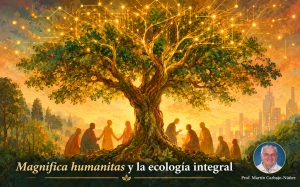
Magnifica Humanitas and Integral ecology (26.10.2026), (45),
in
Blog: www.cssr.news, 45-EN (2026) p. 2
.
The encyclical Magnifica Humanitas addresses the ethical challenges that artificial intelligence (AI) poses to the human person and social coexistence. Its fundamental concern is not technological but anthropological. Rather than focusing on machines, it asks what kind of humanity we are building with them. Do these technologies contribute to building a more fraternal and humane society, or are they reinforcing a new Babel based on control, efficiency, and power?
Rather than merely offering ethical criteria for regulating AI, the encyclical proposes a paradigm shift that would enable us to move from the logic of domination to that of care, fraternity, and gratuitousness. It does not seek a better algorithm, but a more human way of inhabiting the world.
Integral Ecology Includes the Digital Sphere
Magnifica Humanitas is fully in harmony with the reflections developed in Laudato si’, but it broadens the scope of integral ecology to include the digital sphere. More specifically, it shows that, alongside natural ecosystems, there are also technological, communicative, and cultural ecosystems. All of them form part of the common environment we share and for which we are responsible. Consequently, integral ecology cannot be limited to the relationships between human beings, society, and the natural environment. It must also encompass artificial intelligence systems, as well as “patents, algorithms, digital platforms, technological infrastructures, [and] data” (MH 67).
The encyclical agrees with Laudato si’ in identifying the technocratic paradigm as one of the principal causes of the current socio-environmental crisis. However, it extends this diagnosis by showing how artificial intelligence and digital systems intensify the ambition to control, predict, and optimize every aspect of reality. Against this logic, it reaffirms the inalienable dignity of every human person, the value of human limitations, gratuitousness, fraternity, and openness to transcendence.
It also extends the principle of the universal destination of goods to include the informational and technological resources that now profoundly shape social, economic, and cultural life.
It Also Encompasses the Cultural and Communicative Spheres
The encyclical likewise broadens the concept of sustainability, which is not limited exclusively to natural resources but also encompasses digital justice, the quality of communication, and the care of cultural and relational ecosystems.
Sustainability must also apply to the technological and digital spheres, since these are neither immaterial nor environmentally clean or ethically neutral realities. The development of AI, for example, requires energy-intensive data centers, the extraction of rare earth elements, and complex global supply chains. “It is therefore essential to develop more sustainable technological solutions” (MH 102).
The encyclical also emphasizes the need to “promote an ecology of communication” (MH 137) and knowledge. Protecting forests and oceans is not enough; we must also safeguard spaces of dialogue, trust, truth, and encounter, without which human coexistence deteriorates.
To environmental pollution, the encyclical adds informational and cognitive pollution. While the former damages natural ecosystems, the latter harms cultural and relational ecosystems through algorithmic manipulation, disinformation, polarization, and information overload. Integral ecology therefore requires us to prevent the “domination of consciences” (MH 171), protecting the conditions that make discernment, dialogue, and the shared search for truth possible.
Conclusion
Do not be afraid of the new technologies!” (RS 14), John Paul II exhorted. The Church “would feel guilty before the Lord if she did not use them” (EN 45) and if she failed to evangelize the culture they generate. Along these same lines, Leo XIV invites us to approach the technological revolution neither with fear nor with naive optimism, but with discernment.
Artificial intelligence represents an extraordinary opportunity when it remains at the service of the human person and the common good. Nevertheless, a better future cannot be built merely by developing increasingly powerful technologies. Above all, it requires healing the human heart and building together a civilization of care, fraternity, and peace.
Blog Alfonsiana: ("Magnifica Humanitas y la Ecología integral", online); Traduzioni: English; Italiano
Parole chiave: Ecology, Magnifica Humanitas, Laudato si', Digital, fraternity
|