 Carbajo-Núñez Martín ,
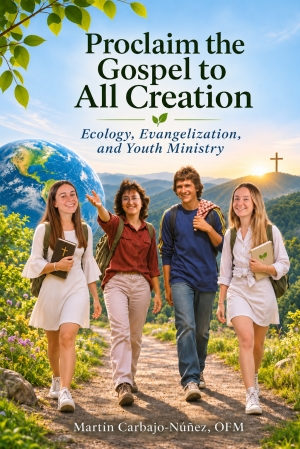
Proclaim the Gospel to All Creation Ecology: Evangelization, and Youth Ministry,
Ed. TAU Publishing,
Carmel (IN) ,
2026
, 316 .
In this new book, Martín Carbajo-Núñez explores the profound connections between integral ecology, evangelization, and youth ministry. The ecological crisis is presented as an ethical, anthropological, and spiritual challenge, since environmental degradation and social injustice are interconnected expressions of a deeper crisis affecting our relationships with God, with one another, and with creation.
Care for creation is an integral dimension of the Church’s evangelizing mission. Jesus’ command to “Proclaim the gospel to every creature” (Mk 16:15) reminds us that the Good News concerns not only humanity’s relationship with God but also the transformation of the relationships through which human life unfolds.
Drawing on recent Church teaching and the Franciscan tradition, the book proposes a relational approach rooted in the conviction that “everything is connected” (Laudato si’, 117). Particular attention is given to young people, who are called to become active participants in ecological conversion and the Church’s evangelizing mission.
At the end of each chapter, practical pastoral guidelines and suggestions for reflection and activities are provided, helping readers translate theological insights into concrete initiatives in youth and vocational ministry, education, and community life.
Inspired by St. Francis of Assisi, the book emphasizes that ecological responsibility, evangelization, and the formation of young people are not three separate tasks, but interconnected dimensions of the Christian vocation to live and proclaim the Gospel within the great community of creation.
Contents:
ABBREVIATIONS 7
1. Biblical Books 7
2. Magisterium Sources and Institutions 7
3. Writings of St. Francis 9
4. Franciscan Sources and Authors 9
5. Bibliographical and Common Abbreviations 9
INTRODUCTION 11
CHAPTER 1: ROOTS OF THE CURRENT ECOLOGICAL CRISIS 17
1.1. An Ethical Crisis 20
1.2. Anthropological Dualism and the Thesis of Human Exceptionalism 24
1.2.1. Ontic Dualism 26
1.2.2. Ontological Dualism 30
1.2.3. The Thesis of Human Exceptionalism 33
1.3. The Technocratic Paradigm and Darwinism 35
1.4. Disembodied Spirituality 38
1.5. Recapitulation 40
1.6. Pastoral Guidelines for Youth and Vocational Ministry 41
1.6.1. Inculturation of the Christian Faith and Its Proclamation (§§ 1.1–1.2) 41
1.6.2. Overcoming the Technocratic Paradigm (§ 1.3) 42
1.6.3. Overcoming Disembodied Spirituality (§ 1.4) 42
CHAPTER 2 INTEGRAL ECOLOGY AND THE RELATIONAL PARADIGM 45
2.1. The Trinity, Origin and Destiny of All That Exists 47
2.2. Overcoming Unhealthy Dualisms 50
2.2.1. Overcoming Ontological Dualism 50
2.2.2. Overcoming Ontic Dualism 54
2.2.3. The Human Person Is Dialogical and Relational 57
2.3. Cooperation and Interdependence: Beyond the Logic of Struggle 59
2.3.1. Sister Mother Earth 62
2.3.2. An Ecology of Kinship 64
2.3.3. Creation as Dialogue and a Place of Encounter 67
2.4. Recapitulation 69
2.5. Pastoral Guidelines for Youth and Vocational Ministry 70
2.5.1. Discerning a Relational Vision of Creation 70
2.5.2. Experiencing Kinship and Dialogue with Creation 71
CHAPTER 3: EDUCATING FOR INTEGRAL ECOLOGY: SPIRITUALITY AND SOCIAL RESPONSIBILITY 73
3.1. The Importance of Education 73
3.1.1. The Family, the First School 76
3.1.2. The Role of Schools 79
3.1.3. Universities as Cultural Laboratories 81
3.2. Spirituality and Mysticism 84
3.2.1. Climbing the Mountain 87
3.2.2. The Metaphor of Pilgrimage 90
3.2.3. Contemplating Nature and Ecological Virtues 93
3.3. Principles of Catholic Social Teaching in an Ecological Key 96
3.3.1. Human Dignity 97
3.3.2. Subsidiarity 98
3.3.3. Solidarity 101
3.3.4. The Common Good and the Universal Destination of Goods 103
3.4. Recapitulation 105
3.5. Pastoral Guidelines for Youth and Vocational Ministry 106
3.5.1. Education, Spiritual Discernment, and Ecological Conversion 106
3.5.2. Practicing Ecological Responsibility (§§ 3.1–3.3) 107
CHAPTER 4: A SITUATION OF SIN AND THE CALL TO ECOLOGICAL CONVERSION 111
4.1. Ecological Sin 114
4.2. Personal Conversion 117
4.2.1. Cultural Conversion 119
4.2.2. Synodal Conversion 122
4.2.3. Pastoral Conversion 125
4.2.4. Ecological Conversion 128
4.2.5. Integral Conversion 130
4.3. The Evangelical Counsels as Ecological Conversion 131
4.3.1. Poverty: Becoming Free and Fraternal 132
4.3.2. Obeying and Listening Rather Than Dominating 134
4.3.3. Chastity: Integrating the Desire for Love and Recognition 136
4.4. Perceiving and Celebrating the Sacramental Dimension
of the Material World 137
4.4.1. “Remember That You Are Dust, and to Dust You Shall Return” 139
4.4.2. The Liturgy Reveals the Sacramental Dimension of the
Material World 140
4.5. Recapitulation 142
4.6. Pastoral Guidelines for Youth and Vocational Ministry 143
4.6.1. Ecological Awareness and Examination of Conscience (§§ 4.1–4.2) 143
4.6.2. The Evangelical Counsels as a Path of Ecological Conversion (§ 4.3) 144
4.6.3. Prayer and Sacramental Life (§ 4.4) 145
CHAPTER 5 THE SACRAMENT OF RECONCILIATION AND OUR RELATIONSHIP WITH THE EARTH 147
5.1. The Acts of the Penitent from an Ecological Perspective 149
5.1.1. Examination of Conscience Concerning Ecological Sin 149
5.1.2. Contrition and the Purpose of Amendment 151
5.1.3. Confession 152
5.1.4. Satisfaction 153
5.2. Celebrating and Strengthening Cosmic Reconciliation 155
5.2.1. Restitution and Ecological Justice 156
5.2.2. Celebrating Restored Fraternity 159
5.3. Recapitulation 160
5.4. Pastoral Guidelines for Youth and Vocational Ministry 161
5.4.1. Receiving Mercy and Discerning Ecological Responsibility (§ 5.1) 161
5.4.2. Ecological Restitution and Restored Fraternity (§ 5.2) 162
CHAPTER 6 HUMAN ECOLOGY: FROM POLARIZATION TO UNITY IN DIVERSITY 165
6.1. Introduction: An Increasingly Polarized World 166
6.2. Polarization and Polar Opposition: Unity That Does Not Eliminate Differences 168
6.2.1. Romano Guardini’s Contribution 168
6.2.2. Pope Francis: Resolving Tensions Without Eliminating Them 171
6.2.3. Applying These Principles to Community Life 172
6.2.3.1. Time Is Greater Than Space 172
6.2.3.2. Unity Prevails Over Conflict 173
6.2.3.3. Realities Are More Important Than Ideas 173
6.2.3.4. The Whole Is Greater Than the Part 173
6.2.3.5. Discernment That Leads to Shared Responsibility 174
6.2.4. The Polyhedron: An Image of Fraternity 174
6.3. Fundamental Polarities of Christian Life 175
6.3.1. Identity and Openness 175
6.3.2. Individual Freedom and Community 176
6.3.3. Truth and Mercy; Norm and Conscience 177
6.3.4. Contemplation and Action; Theology and Pastoral Ministry 177
6.4. Polarization in Consecrated Life 178
6.4.1. Fraternity: Vocational Attraction and Challenge 179
6.4.2. Digital Natives and Digital Immigrants 180
6.4.3. Integrating Self-Denial and Self-Realization 182
6.4.4. Tradition and Renewal: Discerning What Is Essential 183
6.4.5. Authority and Synodality: Distinguishing Roles Without Creating Factions 185
6.5. From Confrontation to a Culture of Encounter 186
6.5.1. Recovering the Educational Meaning of Authority 186
6.5.2. Offering Horizons, Not Merely Imposing Rules 187
6.5.3. Learning to Manage Conflicts Fraternally 188
6.5.4. Translating Encounter into Ecological Cooperation 189
6.6. Recapitulation: Fraternity as Prophecy 189
6.7. Pastoral Guidelines for Youth and Vocational Ministry 190
6.7.1. Overcoming Polarization and Recognizing Differences (§§ 6.1–6.2) 190
6.7.2. Discerning Shared Action amid Conflict (§§ 6.2–6.3) 191
6.7.3. Intergenerational Dialogue and Vocational Discernment (§ 6.4) 192
6.7.4. Building a Culture of Encounter and Ecological Responsibility (§§ 6.5–6.6) 192
CHAPTER 7 EVANGELIZATION FROM AN ECOLOGICAL PERSPECTIVE 195
7.1. Evangelization: Gift and Task 198
7.1.1. An Interactive, Dynamic Process 198
7.1.2. Care for Creation Is an Essential Part of the Church's Mission 201
7.2. Inculturated Evangelization and a Multifaceted Church 203
7.2.1. Inculturated Spirituality, Theology, and Liturgy 205
7.2.2. Participation of the Laity 206
7.2.3. Reciprocal Inculturation: The Church's Openness to Being Evangelized 208
7.3. Awakening the Aesthetic and Contemplative Sense 211
7.3.1. The Via Pulchritudinis 212
7.3.2. Architecture, Theater, and Music 213
7.3.3. The Society of Images 215
7.4. Ecological Responsibility as an Expression of Evangelization 218
7.4.1. An Economy in Service of Integral Ecology 221
7.4.2. Francis of Assisi as a Model of Evangelization 222
7.5. Recapitulation 225
7.6. Pastoral Guidelines for Youth and Vocational Ministry 226
7.6.1. Evangelization through Encounter and Dialogue (§§ 7.1–7.2) 226
7.6.2. Respectful Inculturation and Mutual Learning (§ 7.2) 227
7.6.3. Contemplation, Beauty, and Ecological Responsibility (§§ 7.3–7.4) 227
7.6.4. Digital Communication and Ecological Evangelization (§§ 7.3 and 7.4) 228
CHAPTER 8: SPIRITUALITY, INTEGRAL ECOLOGY, AND YOUTH ENGAGEMENT 231
8.1. The Environmental Crisis in Young People’s Outlook on Life 232
8.1.1. Lifting Our Gaze 235
8.1.2. Learning to Listen and Sing with Creatures 236
8.1.3. Tasting, Smelling, and Touching Creation 237
8.2. From Contemplation to Ecological Conversion 238
8.2.1. “Less Is More” 239
8.2.2. From Personal Action to Sociopolitical Commitment 240
8.3. Recapitulation: Educating for Active Hope 242
8.4. Pastoral Guidelines for Youth and Vocational Ministry 244
8.4.1. Contemplating Creation with Wonder and Gratitude (§ 8.1) 244
8.4.2. Listening to the Cry of the Earth and the Poor (§ 8.1) 245
8.4.3. Ecological Conversion and a Simpler Lifestyle (§ 8.2) 246
8.4.4. Acting Together and Celebrating Active Hope (§§ 8.2 and 8.3) 247
GENERAL CONCLUSION 249
BIBLIOGRAPHY 254
I. Scripture and Ecclesiastical Sources 254
Scripture 254
Ecumenical Councils 254
Papal Documents 255
Dicasteries, Ecclesiastical Commissions, and Synods 258
II. Franciscan and Medieval Sources 260
Saint Francis of Assisi 260
Other Medieval and Franciscan Sources 260
III. Books 262
IV. Collaborative Works and Edited Volumes 265
V. Journal Articles and Chapters in Collective Works 266
VI. Websites and Digital Resources 269
The book has been published in English by Tau Publishing and is available for $16.95 (perfect bound) and for $5.99 as Ebook or PDF
ISBN, perfect bound 978-1-61956-923-2
ISBN, EPUB ebook 978-1-61956-924-9
ISBN, PDF ebook 978-1-61956-925-6
Palabras clave: Ecology, Magnifica Humanitas, Laudato si', Youth Ministry, fraternity, Evangelization
(Fichero adjunto) |